
NEW UPDATES
NEW UPDATES
Fiat Justitia Ruat Caelum
November 24, 2025Dr. Rau P.S Girwar“The Court must apply fiat justitia ruat caelum” “What does it mean?” “It literally means let justice be done though the heavens fall. Basically, the Courts must do justice regardless of the consequence even if it shakes the system or causes hardship.” “So the idea is that justice comes first, and consequences later?” “Precisely. Hypothetically...
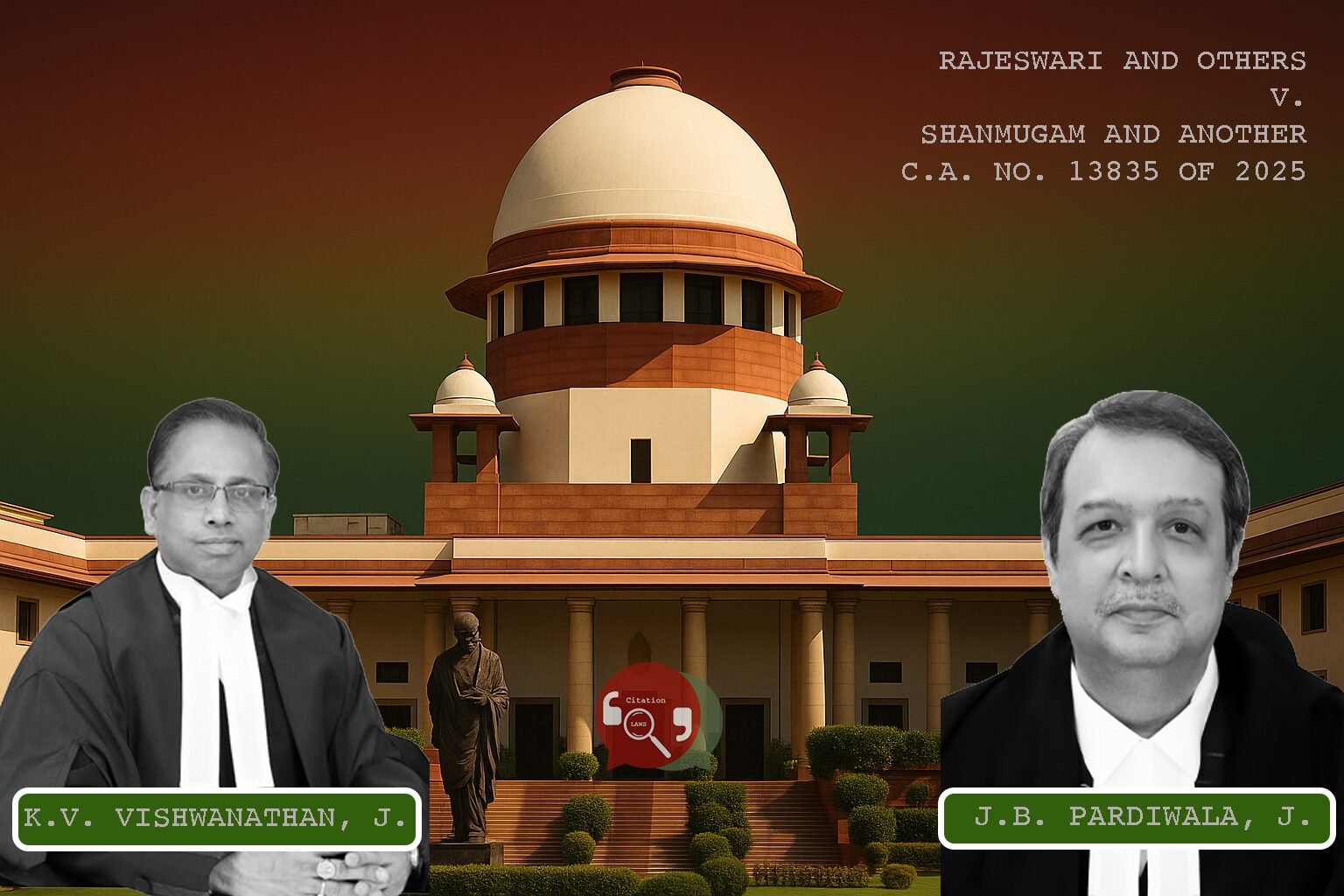
Assignment of decree for specific performance does not require registration: Supreme Court clarifies
November 24, 2025Ms. K.T. RauThe Hon’ble Division Bench of J.B. Pardiwala, J. and K.V. Viswanathan, J. addressed a nuanced but significant question in property and execution law: Whether a deed assigning a decree for specific performance of a sale agreement relating to immovable property required compulsory registration under Section 17(1)(e) of the Registration Act, 1908? The Division Bench held...
Medical opinion not conclusive, cannot take precedence over occular account: Punjab and Haryana High Court
November 24, 2025Ms. K.T. RauIn a recent judgment passed by the Division Bench of Lisa Gill, J. and Parmod Goyal, J. while dismissing a criminal appeal against judgment of conviction passed by the Sessions Court under section 302 IPC and Section 27 of the Arms Act, the Hon’ble Bench categorically observed that witnesses related to the victim are competent...

Mere Long Incarceration not Enough for Bail under UAPA: Punjab and Haryana High Court affirms
November 24, 2025Ms. K.T. RauThe Division Bench comprising of Gurvinder Singh Gill, J. and Ramesh Kumari, J. dismissed the bail applications filed by the accused persons involved in the murder of targeted murder of a Dera Sacha Sauda follower, alleged to be linked to the ongoing sacrilege cases in Punjab. The Bench upheld the dismissal of bail invoking the...

Deemed closure upheld: SC reaffirms employer’s statutory right under Section 25-O of the Industrial Disputes Act, 1947
June 22, 2025Dr. Rau P.S GirwarThe Hon’ble Supreme Court while interpreting the scope of deemed permission to close and undertaking under Section 25-O(3) of the Industrial Disputes Act, 1947 has held that procedural lapses by the State Government cannot frustrate the statutory right of an employer to close a business when no timely decision is communicated by the appropriate authority...
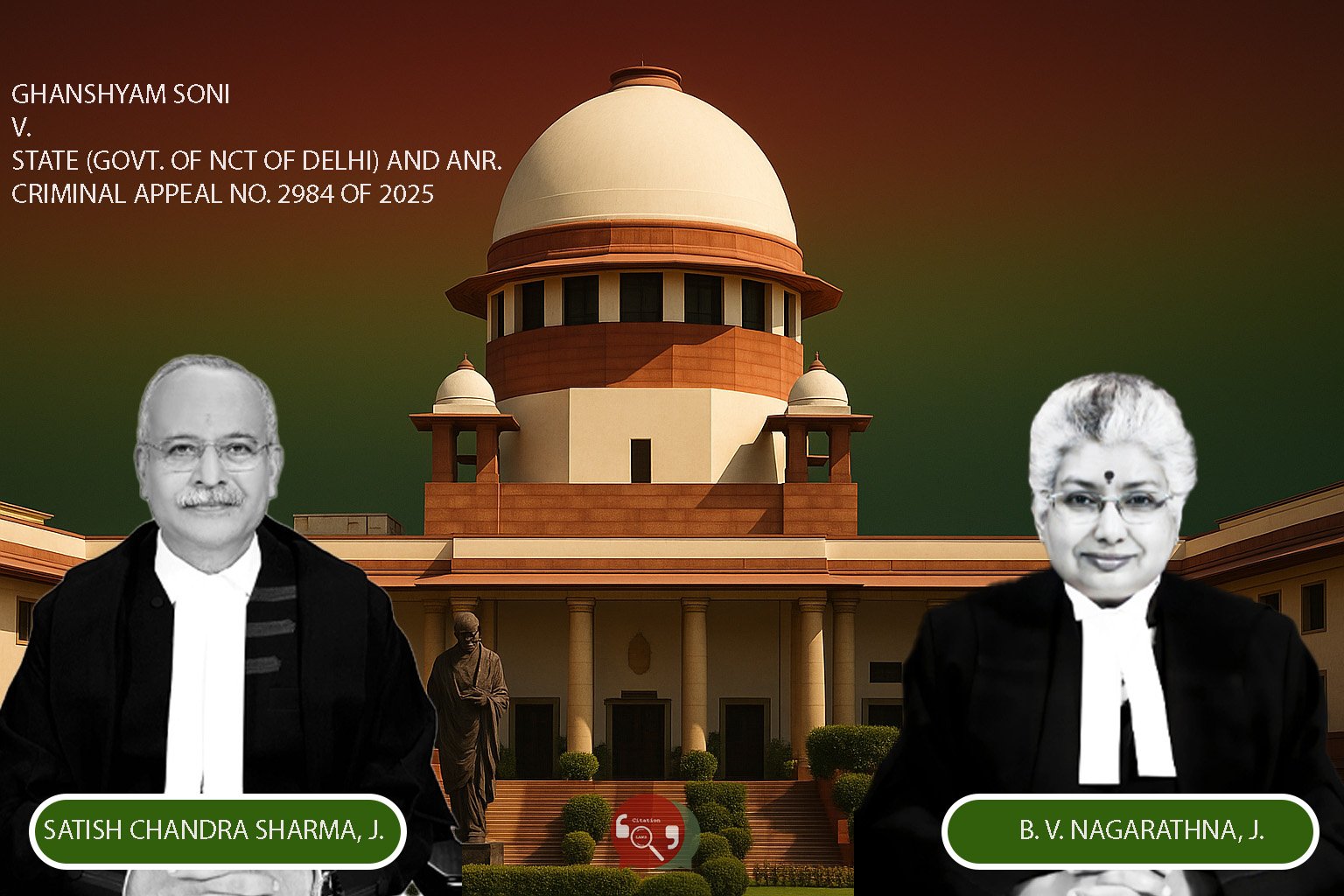
Date of Limitation to be seen from the date of filing of complaint, and not when cognizance is taken: SC Clarifies
June 22, 2025Dr. Rau P.S GirwarThe Bench comprising of Satish Chandra Sharma, J. and B.V. Nagarathna, J. has delivered a significant judgment on the interplay of limitation under Section 468 CrPC and Section 498-A IPC. The Hon’ble Court laid down crucial principles regarding the computation of limitation in continuing offences and addressed the misuse of criminal machinery in matrimonial disputes...
Motive is an essential ingredient in case of circumstantial evidence: SC acquits man of Section 302 IPC after 15 years
June 22, 2025Dr. Rau P.S GirwarINTRODUCTION In a remarkable judgment passed by B.V. Nagarathna, J. and Satish Chandra Sharma, J., the Hon’ble Apex Court on 04.06.2025 acquitted a youth convicted under Section 302 and 201 IPC, 1860 by holding that the circumstantial evidence on record was not consistent and left a reasonable possibility of an alternate outcome i.e. of innocence...
No rape in broken relationships: SC upholds consent between adults
June 17, 2025Dr. Rau P.S GirwarThe Division Bench of the Hon’ble Apex Court comprising of Satish Chandra Sharma, J. and B.V. Nagarathna, J. has once again reiterated that an FIR under section 376(2)(n) IPC, 1860, which is now section 69 of the BNS, 2023 is not maintainable once it is found that the FIR was a result of the relationship...
Continuity and Change: A Jurisprudential Exploration of Punjab Customary Law
June 13, 2025Dr. Rau P.S GirwarPunjab Customary Law, a legal tradition rooted in colonial policy and agrarian patriarchy, occupies a peculiar position in the Indian legal system. Oscillating between statutory law and living custom, its enduring relevance continues to shape property rights, succession, and marital relations, particularly in rural Punjab. This article undertakes an in-depth historical and analytical study of...
- 1
- 2