
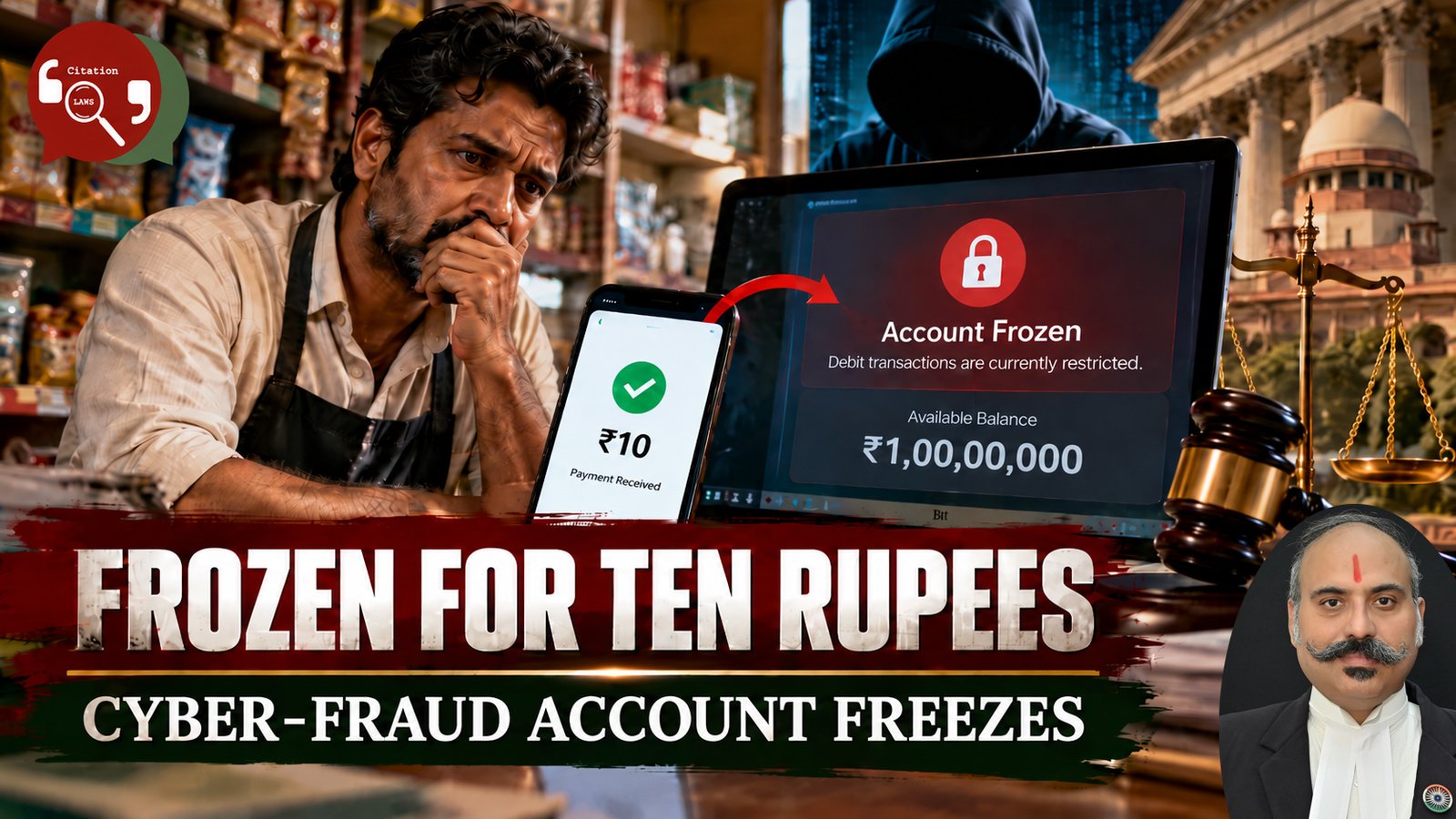
Can a ₹10 UPI payment justify freezing a business account containing crores? Indian courts are increasingly questioning blanket account freezes and emphasising the distinction between disputed money and legitimate working capital.
A shopkeeper sells goods worth ₹10. The customer pays through UPI, collects the goods and leaves. For the shopkeeper, it is an ordinary commercial transaction.
Weeks later, the shopkeeper discovers that the money came through a chain of accounts connected with a cyber-fraud complaint. An investigating agency traces the transaction and instructs the bank to freeze the account.
Suddenly, the trader cannot withdraw money, pay employees, honour cheques, deposit taxes or discharge loan instalments. An entire business may be brought to a standstill over a transaction worth just ₹10.
This situation raises a fundamental legal question:
Can investigating agencies freeze an entire bank account when only a small and identifiable amount is suspected to be connected with cybercrime?
The answer emerging from recent judicial decisions is that investigative action must have a lawful foundation and remain proportionate to its purpose.
The Legal Framework: Sections 106 and 107 BNSS
Section 106 of the Bharatiya Nagarik Suraksha Sanhita, 2023, corresponding to Section 102 of the former Code of Criminal Procedure, empowers police officers to seize property suspected to be connected with an offence.
In State of Maharashtra v. Tapas D. Neogy1, the Supreme Court recognised that a bank account constitutes property capable of seizure during a criminal investigation. However, the existence of a connection between the property and the alleged offence remains crucial.
In Shento Varghese v. Julfikar Husen2, the Supreme Court clarified that delayed reporting of seizure to the jurisdictional Magistrate does not automatically invalidate the seizure. Nevertheless, the decision preserves the Magistrate’s supervisory role and the requirement that seizure powers be exercised within statutory limits.
Section 107 BNSS establishes a separate procedure governing attachment, forfeiture and restoration of property believed to constitute proceeds of crime. The distinction between seizure under Section 106 and attachment under Section 107 has consequently become central to litigation challenging blanket debit freezes.
Punjab and Haryana High Court Protects Legitimate Account Holders
Recent decisions of the Punjab and Haryana High Court demonstrate increasing judicial concern over disproportionate restrictions on banking operations.
In Ajaypal Maan v. Union of India3, Mr. Jagmohan Bansal, J. examined the freezing of a government contractor’s current account. The disputed transaction involved ₹26,450. The petitioner was not named in any FIR, and no attachment order under Section 107 BNSS had been passed by a Magistrate. The Court directed the bank to de-freeze the account within one week while ensuring that the disputed ₹26,450 remained frozen.
The distinction was significant:
The investigation could continue, but the remaining legitimate funds were not required to remain inaccessible.
Similarly, in Sajjan Singh v. Union of India4, the petitioner’s bank account had been subjected to a lien of ₹6,71,000 following a cybercrime alert. The bank acknowledged that no suspicious entry had been found in the account. Considering the absence of a suspicious transaction, criminal proceedings against the petitioner and a Magistrate’s attachment order, the High Court directed de-freezing within three days.
These decisions reinforce the principle that an automated alert or investigative suspicion cannot, without adequate factual and legal justification, become an indefinite restraint upon an individual’s banking activities.
A Lien Cannot Automatically Become a Blanket Freeze
In Neelkanth Pharma Logistics (P) Ltd. v. Union of India5, the Delhi High Court examined the legality of freezing accounts where allegedly tainted funds were identifiable. The decision has subsequently been relied upon in cases distinguishing seizure under Section 106 BNSS from attachment requiring judicial intervention under Section 107.
Other High Court decisions, including Headstar Global Pvt. Ltd. v. State of Kerala6, and Kartik Yogeshwar Chatur v. Union of India7, have contributed to this developing judicial approach.
The central principle is proportionality.
If ₹500 connected with an alleged fraud enters an account containing ₹5 lakh, preserving the disputed ₹500 may adequately safeguard the investigation. Freezing the entire ₹5 lakh requires a separate and legally sustainable justification.
This does not mean that every account must be released immediately. Where the account is itself allegedly used for money laundering, the transactions cannot be separated, or the investigation reveals complicity, broader restrictions may be justified through the applicable legal procedure.
PAN-Wide Blocking: An Emerging Constitutional Concern
A particularly troubling issue identified in the underlying research concerns restrictions extending beyond the receiving account.
Some account holders experience restrictions across different banks or face difficulty opening fresh accounts because their PAN or banking identifiers have been flagged. Such measures raise questions concerning statutory authority, natural justice and proportionality.
An account having no demonstrated connection with the alleged fraudulent transaction cannot automatically be treated as tainted merely because its holder owns another account under investigation.
The constitutional implications may involve Article 14, guaranteeing equality and protection against arbitrariness; Article 19(1)(g), protecting the freedom to carry on trade or business; Article 21, including livelihood interests; and Article 300A, protecting against deprivation of property except by authority of law.
However, the legality of PAN-wide restrictions must be assessed on the actual banking instruction, applicable regulatory framework and factual circumstances. The broader contention that an unrelated account cannot be restrained without lawful justification remains an important issue for judicial determination.
The Economic Cost of Freezing an Innocent Business
The consequences of blanket freezing extend far beyond the disputed transaction.
A business may default on GST payments, salaries, supplier obligations and loan instalments despite having sufficient money in its account. Cheques may be dishonoured, creditworthiness may be affected and commercial relationships may suffer.The damage can be particularly severe for small traders operating on limited working capital.
The purpose of financial investigation is to trace criminal proceeds and protect victims, not to inflict disproportionate financial hardship upon persons whose involvement in the offence remains unestablished.
Remedies Available to an Affected Account Holder
An affected trader should first obtain written information from the bank identifying the investigating agency, NCRP or FIR reference, disputed amount and precise nature of the restriction.
Invoices, GST records, account statements and relevant commercial documents can establish that the payment was received in the ordinary course of business.
A representation may then seek release of the account subject to a lien over the identifiable disputed sum, accompanied by an undertaking to cooperate with the investigation.
Where administrative or statutory remedies do not provide effective relief, proceedings before the competent Magistrate or a writ petition under Article 226 may be considered, depending upon jurisdiction and circumstances.
The Ministry of Home Affairs’ 2026 cyber-fraud grievance framework and subsequent judicial developments also underline the importance of effective grievance redressal and timely review of account restrictions.
Freeze the Suspected Money, Not the Entire Business
Cybercrime victims are entitled to effective investigation and lawful preservation of stolen funds. Equally, an innocent merchant cannot automatically be treated as a criminal merely because a customer transferred money later traced to a fraudulent transaction.
The developing judicial approach seeks to reconcile both interests.
Where the disputed amount can be identified and preserved, a blanket freeze of unrelated funds demands compelling legal justification.
The rule of law requires investigators to trace the money, establish the necessary connection and use powers proportionately. A transaction worth ₹10 should not, by itself, become a sentence of financial paralysis for an otherwise legitimate business.
To dive deeper into the topic, read the research paper written by the author on this topic.