
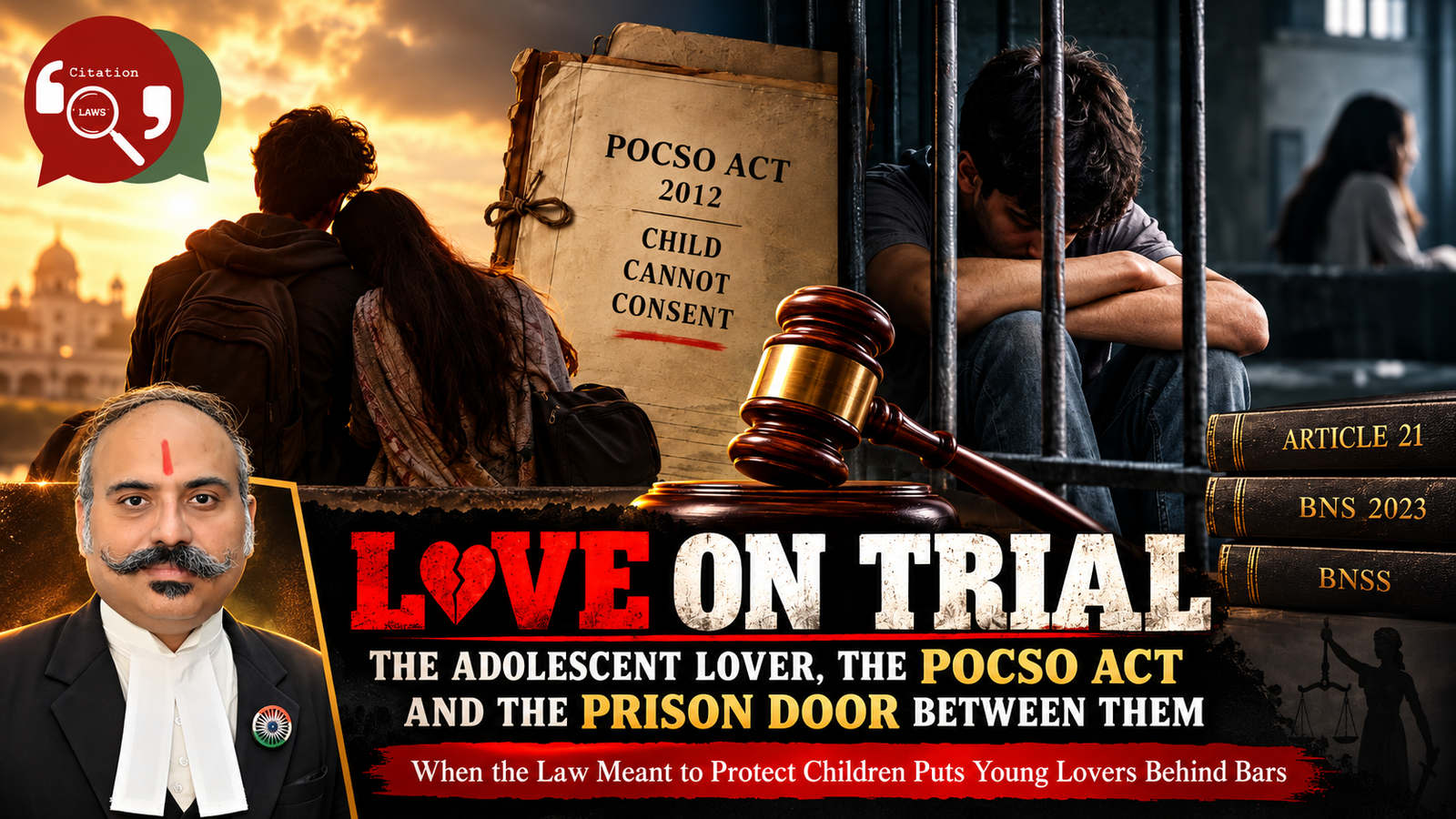
When a law designed to protect children sends a young lover to prison, the criminal justice system faces a difficult question: where does adolescent affection end and sexual exploitation begin?
When the Law Cannot See Beyond a Date of Birth
What happens when a seventeen-year-old girl insists that she loves a nineteen-year-old boy, but the criminal justice system sees only a victim and an accused? This question has occupied my thoughts because it exposes one of the most delicate tensions in contemporary criminal law. A statute intended to protect children from sexual predators may, in certain circumstances, become the instrument through which a relationship between young persons is criminally prosecuted, sometimes at the insistence of families opposed to their union. I cannot dismiss the importance of protecting minors merely because a relationship is described as consensual. Equally, I cannot overlook the consequences of prolonged incarceration, disrupted education, fractured families and the emotional suffering of a young woman whose wishes may receive little practical attention. The deeper concern is whether the administration of criminal justice possesses sufficient flexibility to distinguish exploitation from adolescent affection without compromising children’s safety. That unresolved conflict between statutory protection, individual liberty and adolescent welfare provides the foundation for examining how India’s POCSO framework operates—and whether it requires carefully defined reform.
A Relationship That Becomes a Criminal Prosecution
Consider a nineteen-year-old boy and a seventeen-year-old girl who leave their homes intending to live together. The girl’s family registers an FIR alleging kidnapping and sexual assault. When the couple is recovered, the girl tells the investigating officer or Magistrate that she accompanied the boy voluntarily.
Her statement may be relevant to disputed factual allegations, but it cannot create legal capacity to consent to sexual activity under the Protection of Children from Sexual Offences Act, 2012.
Section 2(1)(d) of POCSO defines every person below eighteen as a child. Sections 3 and 4 prescribe punishment for penetrative sexual assault, including a minimum sentence of ten years for the general offence and twenty years where the child is below sixteen.
Section 63 of the Bharatiya Nyaya Sanhita, 2023 similarly recognises eighteen as the statutory age threshold for consent in rape law.
Consequently, a relationship that the participants regard as voluntary can still result in serious criminal charges.
The challenge is not whether genuine sexual exploitation deserves punishment. It unquestionably does. The challenge is whether every relationship involving a person below eighteen necessarily reflects the same circumstances of abuse, coercion or predation.
The Supreme Court Recognises the Problem
The question assumed renewed importance in State of Uttar Pradesh v. Anurudh1 wherein the Hon’ble Supreme Court considered directions issued by the Allahabad High Court requiring medical age determination in POCSO investigations. It disapproved blanket directions that departed from the statutory procedure. More significantly for the wider debate, the Court acknowledged concerns about the use of POCSO proceedings in cases involving adolescent relationships and drew attention to the possibility of legislative measures addressing genuine close-in-age relationships.
Such a reform is commonly described as a Romeo-Juliet clause.
The concept does not justify sexual exploitation. Instead, it contemplates a narrowly defined legal distinction between relationships involving young persons close in age and conduct involving substantially older offenders, coercion, grooming or abuse of authority. The Supreme Court’s observations do not themselves establish an exception. Until Parliament amends the legislation, the existing statutory definition of a child continues to govern.
Consent, Autonomy and the Constitutional Dilemma
A related development arose in In Re: Right to Privacy of Adolescents2. In August 2024, the Supreme Court rejected an approach that had permitted acquittal notwithstanding the statutory protection afforded to a minor. Subsequently, in its decision dated 23 May 2025, the Court examined the extraordinary personal circumstances of the young woman concerned. Recognising the consequences that imprisonment would have for her and her child, the Supreme Court exercised its powers under Article 142 of the Constitution and declined to impose a sentence despite maintaining the conviction. The decision illustrates the significance of human welfare in criminal adjudication.
However, Article 142 relief cannot be mistaken for a general statutory defence available in every POCSO prosecution. The Court expressly treated the intervention as exceptional. For ordinary trial courts, statutory mandatory minimum sentences remain binding unless a legally applicable exception exists.
What Happens to the Young Accused?
The consequences of prosecution frequently begin long before guilt is determined. Arrest may interrupt education, employment and family life. Bail proceedings may continue while the accused remains incarcerated, even before the prosecution evidence has been fully examined.
Sections 29 and 30 of POCSO Act introduce special statutory presumptions, making the evidentiary landscape particularly consequential. At the same time, a young woman may experience repeated interviews, family pressure, institutional intervention and uncertainty about her future.
These consequences cannot justify overlooking genuine abuse. But they do demonstrate why investigation must distinguish between evidence of exploitation and allegations arising primarily from family opposition. Where the accused is himself below eighteen, the Juvenile Justice (Care and Protection of Children) Act, 2015 supplies a separate procedural framework. In qualifying heinous-offence cases involving children aged sixteen to eighteen, a preliminary assessment may arise under Section 15.
Thus, the law may simultaneously regard one adolescent as a protected child and another as a child in conflict with law.
The Law Commission’s Proposed Solution
The Law Commission of India addressed this difficult issue in its 283rd Report, submitted on 27 September 2023.
After examining proposals to lower the age of consent or introduce an exception for adolescent relationships, the Commission recommended retaining eighteen as the statutory threshold. However, it also recognised that cases involving factual willingness between adolescents aged sixteen to eighteen may not always warrant the same sentencing consequences as cases involving predatory sexual abuse.
The Commission therefore proposed guided judicial discretion in sentencing, subject to appropriate legislative amendments.
The essential distinction is between reducing protection for minors and permitting courts to assess exceptional factual circumstances when determining punishment.
A Narrow Romeo-Juliet Exception
One possible legislative response would be a carefully restricted close-in-age exception. Such a provision could require that the younger person be at least sixteen, the difference in age remain within three or four years, and the relationship be free from coercion, grooming, threats, exploitation, trafficking or any abuse of authority.
It would also require reliable evidence that the younger person’s participation was voluntary in fact, while recognising that legal consent remains unavailable unless Parliament creates an exception. This approach would preserve the protection afforded to children while recognising the difference between predatory exploitation and relationships between near-equals.
The risk of manipulation must nevertheless remain central. A claim of romance, a subsequent marriage or even a favourable statement cannot automatically establish the absence of exploitation.
The Equilibrium Test: A Practical Judicial Approach
A useful framework for examining these cases is the Equilibrium Test, proposed in the underlying research. It asks courts to consider five connected factors:
- the age difference,
- the adolescent’s independently recorded account,
- the existence of authority or dependency,
- evidence of harm or coercion, and
- the actual welfare consequences for the young person concerned.
These factors cannot override the statutory elements of a POCSO offence or create a new defence. They can, however, assist courts when deciding legally permissible questions concerning bail, evidence, investigation and welfare.
For advocates, the immediate priorities should be accurate age determination, obtaining the statement recorded under Section 183 BNSS, examining any evidence of coercion or grooming, and ensuring that the bail court receives a complete factual account.
The Supreme Court’s observations in Anurudh must be read alongside the principle that a bail proceeding is not a substitute for a full trial.
Justice Must Protect Without Losing Its Humanity
The debate surrounding POCSO and adolescent relationships is not a contest between children’s rights and the liberty of accused persons. Both are integral concerns of a constitutional legal system.
Sexual exploitation must remain punishable with the seriousness it deserves. At the same time, criminal justice must recognise the devastating consequences of unnecessary incarceration, unreliable age allegations and prosecutions driven by family hostility rather than actual exploitation.
The task before Parliament is to construct a carefully defined legal distinction without creating a loophole for predators. Until that happens, investigators and courts must apply the existing law faithfully while exercising every available procedural safeguard with fairness, sensitivity and constitutional responsibility.
A child-protection law must remain a shield against exploitation. It should never become a weapon for settling family disputes.
To dive deeper into the topic, read the research paper written by the author.